
Using WISE in Thailand?
The Bank of Thailand's licensing of Wise as a local financial entity is a massive milestone for digital banking—but it comes with serious, unexpected tax implications for foreign residents.
6/8/20267 min read
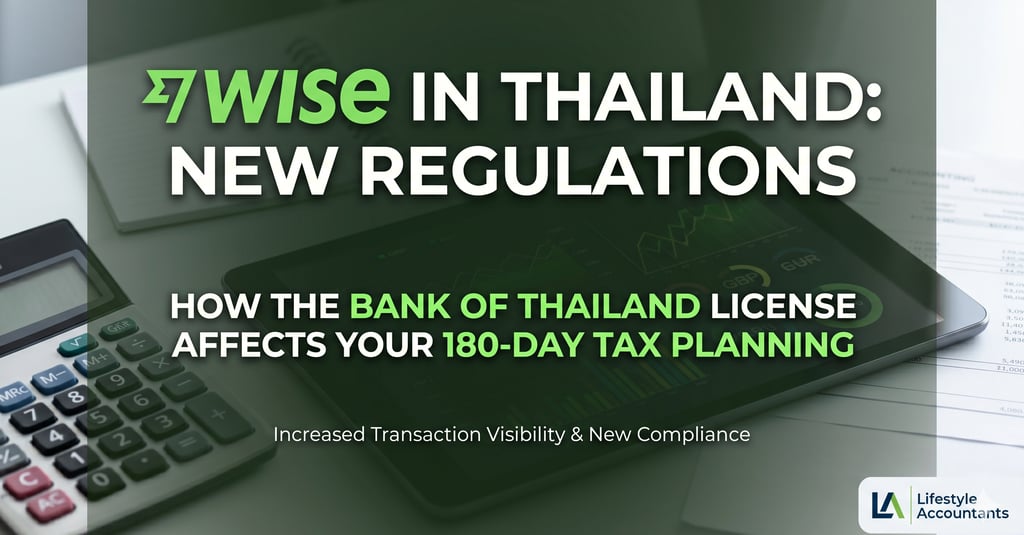
With the upcoming August transition deadline, Thailand-registered accounts will face tighter local compliance, additional verification, and automatic currency conversions. Crucially, it means significantly greater transaction visibility for funds entering the Thai tax net.
If you spend over 180 days a year in Thailand and use Wise as your primary conduit for foreign income or investments, proactive tax planning is no longer optional. The way you structure your remittances now will dictate your local tax liability.
At Lifestyle Accountants, we are actively helping clients navigate these regulatory shifts safely and legally.
👇 Read our full breakdown of the new rules and how to protect your assets:
Wise is rolling out a series of significant structural changes for accounts registered with a Thai address. The timeline for these updates depends on when the account was created:
Accounts registered after January 21, 2026: Changes take effect progressively by June 2026.
Accounts registered before January 21, 2026: The new Customer Agreement and restrictions take effect on August 3, 2026.
The shift brings a mix of local conveniences alongside restrictive, and potentially costly, multi-currency limitations.
1. What is Changing?
The Downsides & Restrictions
Forced Currency Conversion on Incoming Funds: If you receive non-THB payments from a third party (e.g., a pension payment, a client transfer, or a transfer from another Wise user into your foreign IBAN/routing details), Wise will automatically convert it to Thai Baht (THB) immediately at their mid-market rate. You can no longer hold that foreign currency in your balance to wait for a better exchange rate.
Note: This does not apply if you are topping up your Wise balance from your own linked, matching foreign bank account.
The "Double Conversion" Trap for Global Transfers: If you try to send money between two non-Thai accounts (e.g., transferring USD from Wise to a UK bank account), the funds must now route through THB first. It will convert from USD to THB, and then from THB back to GBP, hitting you with two sets of conversion fees.
No Local ATM Withdrawals: Wise cards issued under a Thai address will no longer work at ATMs inside Thailand. They will still work for local point-of-sale spending, online shopping, and at ATMs outside of Thailand. Existing cards will be canceled by September 2026, and Wise will offer free local replacements.
Discontinuation of Interest and Stocks: Wise will no longer offer its "Interest" or "Stocks" investment features to Thailand-based accounts. Any remaining balances in these features will be automatically sold off and moved into cash balances.
New Transaction and Account Limits:
Outward remittances: Capped at 800,000 THB per day when sending money out of Thailand.
Internal conversions: A maximum limit of 750,000 THB per day when converting THB to another currency.
Daily spending/transfer limits: A starting cap of 30,000 THB per day for multi-currency account payments, alongside a strict limit of 10,000 THB per individual transaction for THB transfers.
The Upsides & New Features
Direct Outward THB Transfers: For the first time, you can legally and easily send THB out of Thailand to an overseas bank account directly from your Wise THB balance or a linked Thai bank account using competitive mid-market rates.
Local Payment Integration: Your Wise app will fully support PromptPay QR code scanning, meaning you can use your Wise THB balance to pay local vendors and street markets across Thailand. You can also top up your Wise account directly from a local Thai bank account.
2. Why Are These Changes Happening?
The root cause isn't a product choice by Wise, but a regulatory transition. Wise has secured a non-bank financial services license from the Bank of Thailand.
To legally operate within the country as a localized entity—operating as Wise Payments (Thailand) Limited—they must fully comply with strict Thai central bank regulations and capital control frameworks. These laws are designed to track money flowing in and out of the country, limit residents from holding unregulated foreign currency assets locally, and bring all local payment methods (like PromptPay) under tight domestic oversight.
3. The Bigger Picture: Thai Tax Implications
For expats who are considered Thai tax residents (spending 180 days or more per year in the country), these changes have a massive secondary impact on tax planning:
Loss of Timing Control: Previously, expats could receive foreign income into a Wise foreign currency pocket (like USD or GBP) and choose to hold it there, only moving it into Thailand during a later tax year to mitigate tax liabilities.
Instant Remittance Mapping: Because incoming third-party foreign funds are now automatically converted to THB and held under a Thai-regulated entity, it creates immediate visibility. Tax authorities have a much stronger basis to treat these automated incoming transactions as remitted foreign income, pulling them directly into the Thai tax net for that specific calendar year.
If your entire international cash flow runs through a Thai-registered Wise account, you may need to re-evaluate how your funds are structured before the August 2026 deadline kicks in.
For a deeper dive into how these shifts alter financial structures and potential workarounds, continue reading.
Q&A: Here is an example of what this means for an expat living in TH for more than 180 days. He moves money from a UK bank account in his name to his Wise TH account.
Q: If i transfer money from my UK bank GBP into Wise to hold it there, will it auto convert?
A: No, it will not auto-convert, provided you do the transfer correctly.
Wise has explicitly carved out an exception for self-top-ups. Their official policy states that you can still add money to any of the 40+ currencies in your Wise multi-currency account from your own matching foreign bank account, and it will remain in that currency without any forced conversion to Thai Baht (THB).
To ensure your GBP stays as GBP, you need to be mindful of how the funds enter your account.
Self-Top-Up via the App - (You log into Wise, select your GBP balance, click "Add", and fund it via your linked UK bank account or debit card) - Wise recognizes this as a self-funding action. You can safely hold the GBP and choose when to convert it later. = NO Auto Convert
Direct Bank Transfer - (You manually send GBP from your UK bank app using your own name to your Wise GBP local account details) - As long as the sending account name matches your Wise account name exactly, it counts as a self-top-up. = NO Auto Convert
Third-Party Transfers - (A pension provider, UK private business, friend, or client sends GBP directly to your Wise GBP account details) - Because the funds originate from a third party, Wise's new Thai-entity rules mandate an immediate, automatic conversion to THB at the mid-market rate. = YES it Auto Converts
One Critical Detail: The "Double Conversion" Trap
While you can safely hold your own GBP in your account, be very careful if you ever plan to send that money out of Wise to another non-Thai account later (for example, if you hold GBP but later want to send it to a USD or EUR account overseas).
Under the new Bank of Thailand regulations, a Thai-registered Wise account cannot execute a direct foreign-to-foreign transfer. The path will look like this: GBP - THB-USD
Because it forces a stopover in Thai Baht, you will be hit with two separate currency conversion fees.
If your plan is simply to park your own UK funds in GBP and gradually convert them to THB as you need them to live on in Thailand, your workflow remains completely safe from auto-conversion.
The Immediate Headaches This Creates
Total Loss of Timing Control: You can no longer leave those dividends sitting safely in a GBP pocket inside Wise while waiting for the exchange rate to improve or planning your tax year. The conversion happens the moment the money hits Wise.
The Thai Tax Trap: Because a Thai-regulated entity (Wise Payments (Thailand) Limited) is automatically processing and converting these third-party funds, the transaction becomes immediately visible. For anyone spending 180+ days a year in Thailand, the Revenue Department has a very clear, automated paper trail to treat those converted dividends as remitted foreign income taxable within that specific calendar year.
Q: So if i have a pension, investment receipts and dividend payments etc coming into my Wise account on different days of the month, i will incur 3 lots of auto conversion rates and charges?
A: If those three separate payments land in your Thai-registered Wise account on different days, they will trigger three separate automatic conversions.
Each individual incoming transfer will be intercepted, subjected to Wise's standard currency conversion fee (which usually ranges between 0.35% and 0.5% for GBP to THB depending on the volume), converted at that exact day’s mid-market exchange rate, and deposited into your account as Thai Baht.
This approach introduces three distinct headaches for managing your cash flow:
1. The Cost Outlay (Fees & Rate Volatility)
While Wise doesn't charge an extra "penalty fee" for automatic conversions—you still get their standard, competitive mid-market rate and transparent percentage fee—you completely lose the ability to bundle your funds. Instead of waiting for a favorable exchange rate spike to convert one large lump sum, you are forced to accept whatever the exchange rate happens to be on those three specific days of the month.
2. A Disjointed Thai Tax Trail
This is the most critical issue for long-term planning. Because these three transactions hit a Thai-regulated entity (Wise Payments (Thailand) Limited) on three separate dates, they generate three distinct, automated records of remitted foreign income.
If you are a Thai tax resident, trying to audit, track, and declare your income across dozens of small, auto-converted entries throughout the tax year becomes a compliance nightmare compared to bringing in clean, controlled bulk transfers.
3. Immediate Exposure to Account Limits
Because all three incoming streams immediately push your THB balance up, you instantly run into Wise’s strict new daily operational walls for Thai accounts:
You are capped at a 10,000 THB per transaction limit for making standard THB payments or outbound transfers from that balance.
Your daily multi-currency account spending/transfer limit starts at a restrictive 30,000 THB per day (though Wise states this may scale up automatically over time based on account history).
Q: How can I mitigate this?
A; ## The Legal and Stable Workarounds
To create that "personal buffer account" without violating residency rules, you have three distinct paths:
The "Expat / International" Banking Arms (Best Long-Term Fix)
The major UK banking groups operate separate, fully legal "International" divisions—usually based in the UK Crown Dependencies (Jersey, Guernsey, or the Isle of Man).
These accounts give you a standard UK sort code and account number (meaning the DWP, investment platforms, and your UK company can pay into them smoothly without paying international transfer fees), but they are specifically designed for people living permanently abroad in places like Thailand.
HSBC Expat (Jersey): One of the most popular choices. If you maintain a certain balance or have a high salary, there is no monthly fee. It links seamlessly with global transfers.
Lloyds Bank International or NatWest International: Both offer expat checking accounts in GBP. They usually charge a small monthly fee (around £5 to £8) which is waived if you maintain a minimum balance (typically £5,000).
Services
Tailored financial solutions for your business success.
email: wantana@lifestyleaccountants.com
Phone: +6682 942 1150
© 2026. All rights reserved. Lifestyle Accountants
99/268 Supalai Park Ville
Lumpho, Bangbuathong
Nonthaburi 11110







Scan or click